Building multi-agent AI systems that actually talk to each other, and the contract that controls what they can say.
William Hill · Forward Deployed Engineer · RenderATL
Commit Your Code 2026 · deck v1.6.0
@emjay_hill · william@renderatl.com
SLIDES + SOURCES
From one community to another
Render(ATL)
See you at RenderATL 2027
August 18–19 · Downtown Atlanta
The South's tech conference.
RENDERATL.COM
Five summits · One badge · One price
By the end of this talk
You will know how to find whether the model or its knowledge limits your AI feature.
And you will have a rule for when to write that knowledge down as a contract, and when not to bother.
THREAD 01: THE FAILURE
Every morning, you are the integration layer
The forecast is in a weather app.
Your schedule is in a calendar.
What you actually own is in a closet.
15 shirts and 10 pairs of pants make 150 outfits.
You can put on a lot of stuff. That does not mean you are putting that sh*t on.
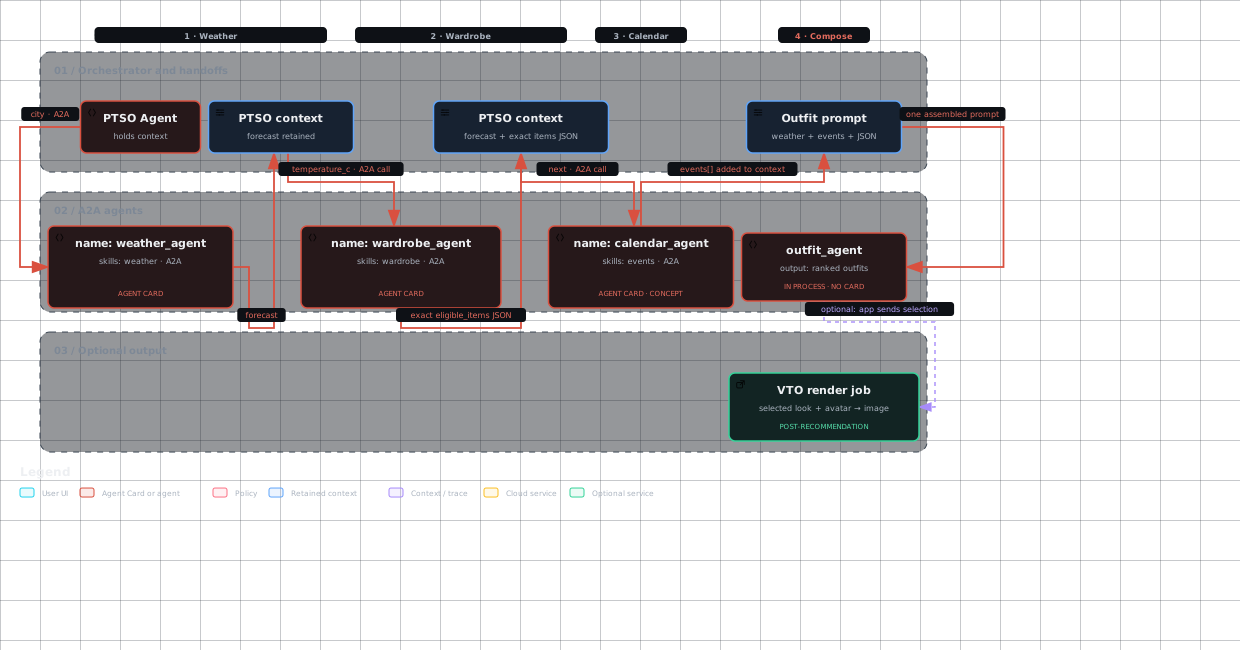
PTSO's A2A orchestration path
Put That Sh*t On. Give it a city, get ranked outfits from clothes I own.
Agent Cards describe each A2A endpoint. MCP supplies weather and wardrobe data. PTSO calls the endpoints in sequence, keeps every result, and sends one prompt to the in-process outfit agent.
Rain in the forecast. Suede in the outfit.Before ontology validation
What PTSO knew about my closet
PTSO knew the forecast, and it knew the fabric. Nothing connected the two.
Six recommendation fields: type, category, brand, color, fabric, style.
Enough to filter a list. Not enough to justify a choice.
The suede loafers matched on color, on style, and on temperature. Every check the system had, passed.
Not one of them knows what rain does to suede.
What PTSO knew about my closet
Better agents did not give me better answers
I tuned the orchestration. I improved the prompts. I moved to newer models.
The same knowledge gap remained.
Model upgrades did not give PTSO the missing rule.
HOT TAKE ALERT
What PTSO knew about my closet
What if hallucination is a feature, not a bug?
Generative models need freedom to propose new combinations.
That freedom can also produce unsupported claims.
Model improvements alone cannot enforce every domain rule.
Put the invariant outside the model.
Frank Coyle, UC Berkeley — Why Agentic Systems Need Ontologies
What PTSO knew about my closet
PTSO was missing a stronger substrate
The model had data.
It did not have enough rules about what that data meant.
The ontology made those rules explicit and checkable.
THREAD 02: THE RULEBOOK
What is an ontology?
"An explicit specification of a conceptualization."
Thomas Gruber, 1993. This is the definition the field actually uses.
Defining the term
Dude, what?
Defining the term
In plain English: an ontology is a rulebook for your data
The names for each thing.
What each name means.
The allowed combinations.
Written down in one place, outside the model, where anything can check it.
Defining the term
Your closet is already an ontology
This rulebook is your taste. You already follow every line of it. Software cannot read any written copy.
THREAD 03: THE CONTRACT
PTSO's contract knows facts that nobody typed
A human typed wool blend. A human typed navy marl twill.
Nobody typed layers over the merino crewneck.
PTSO worked that one out, and it names the rule that did it.
The ontology inside PTSO
One blazer row, nine evidence edges
Jetsetter Knit Blazer · Navy Marl Twill · Bonobos
The evaluator returns valid, score, violations, and repair_candidate_ids.
The model proposes. The ontology disposes.
Outfit validation flow
The failure path is bounded
One repair call, then fallback
Live demo fallback
What should I wear tomorrow?
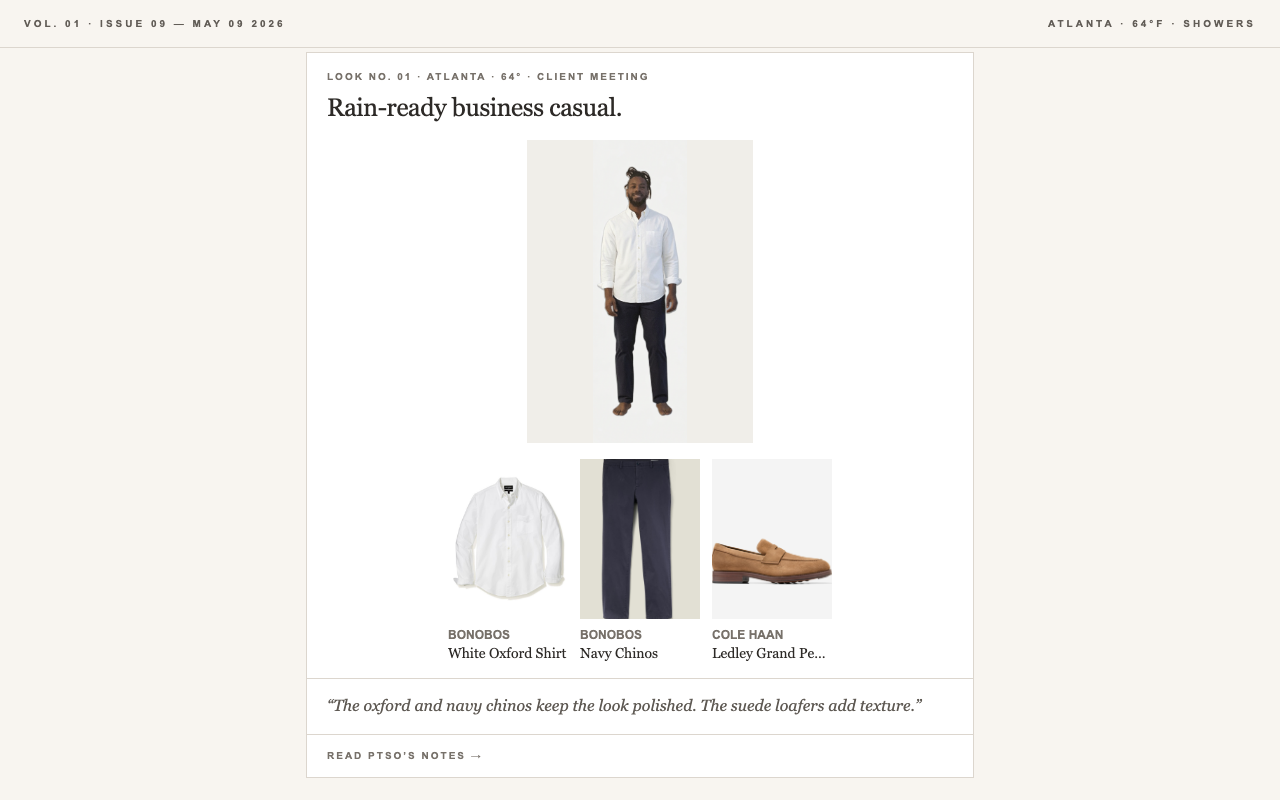
Silent demo: The presenter asks, “What should I wear tomorrow?” PTSO returns three Atlanta casual looks. Each look includes a shirt, trousers, shoes, a virtual try-on image, and an explanation.
What I learned
Every version of PTSO gave the model less to decide
V1 — one orchestrator and three specialist model calls. Three A2A delegations.
V2 — the product endpoint bypassed the orchestrator and called outfit_agent directly.
V3 — rules validate every agent proposal. One repair is allowed before fallback.
Every version gave the model fewer decisions that software could make reliably.
What I learned
So should you build an ontology? Maybe.
Build it when two systems must agree on a word, a wrong combination costs money, or the rule outlives the prompt.
Skip it when one codebase reads the data, a retry is cheap, or you cannot write the rule in a sentence.
Illustrative patterns
What this looks like outside a closet
Clinical. A clinical system could check known interaction rules.
Access control. An access system could limit the rows before model access.
Manufacturing. A manufacturing system could reject incompatible parts.
The pattern stays the same. The agent proposes. The contract decides what survives.
What I learned
Models propose. Contracts dispose.
If an answer sounds right but violates a rule, write the rule where software can check it.
Let the model propose. Let the contract decide what survives.
CYC 2026 · v1.6.0 · ← → move · o overview · f full screen